Learn about capital gains tax on property in India in 2026, including tax rates, calculation examples, exemptions, TDS and tips for property sellers.
Capital Gains Tax on Property in India 2026: A Complete Seller’s Guide
Selling a property can be financially rewarding, but understanding the tax on your profit is just as important as negotiating the right selling price. Whether you are selling a residential house, an apartment, a commercial property or a plot of land, capital gains tax on property in India can affect how much money you finally receive from the sale.
In 2026, property sellers also need to understand the transition to the Income-tax Act, 2025, effective from 1 April 2026. This guide explains the basics of capital gains tax, how to calculate your taxable profit, available tax-saving options and the checks to complete before selling a property.
Capital gains tax is the tax payable on the profit earned when you sell a capital asset, such as land, a house or an apartment.
For example, suppose you purchased a residential plot for ₹20 lakh and later sold it for ₹35 lakh. Your initial profit is ₹15 lakh before considering eligible expenses, improvement costs and applicable tax provisions.
However, the entire selling price is not automatically taxable as profit. The calculation depends on the purchase cost, eligible expenses, holding period and applicable exemptions.
The period for which you own a property determines whether the profit is treated as a short-term or long-term capital gain.
- Short-term capital gain: The property is held for 24 months or less before its transfer.
- Long-term capital gain: The property is held for more than 24 months before its transfer.
Short-term gains are generally taxed according to the applicable income-tax slab rates. Long-term gains from property are generally subject to the applicable long-term capital gains tax provisions.
Always confirm the relevant holding-period rules and tax treatment for your transaction before calculating the final liability.
What Is the Capital Gains Tax Rate in India in 2026?
For long-term gains from land or buildings transferred on or after 23 July 2024, the general tax rate is 12.5% without indexation, subject to applicable provisions.
A special grandfathering provision is available to resident individuals and Hindu Undivided Families (HUFs) for land or buildings acquired before 23 July 2024. If the tax calculated under the new method is higher than under the earlier method, the excess may be disregarded under the applicable conditions.
Under this provision, eligible taxpayers may benefit from the earlier 20% rate with indexation when it results in a lower tax liability.
Short-term gains are generally taxed at the applicable slab rates. Surcharge and health and education cess may also apply, depending on the taxpayer's circumstances.
Important: The Income-tax Act, 2025 applies from 1 April 2026, while earlier tax years remain subject to the relevant transition provisions. Verify the applicable rules for the tax year in which your transaction falls.
How to Calculate Capital Gains on Property
Before estimating your tax liability, identify the sale value, purchase cost and eligible expenses.
A simplified calculation is:
Capital Gain = Sale Consideration − Eligible Transfer Expenses − Acquisition Cost − Eligible Improvement Cost
For long-term property acquired before 23 July 2024, eligible resident individuals and HUFs should also compare the applicable calculation methods where grandfathering relief is available.
Example: Selling a Property for a Profit
Suppose you purchased a plot for ₹25 lakh and sold it for ₹45 lakh.
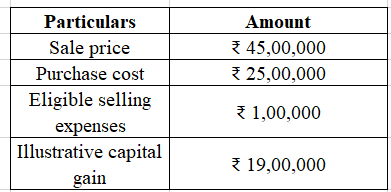 image.png 9.75 KB
If the entire ₹19 lakh is taxable as a long-term capital gain at 12.5%, the illustrative tax would be ₹2,37,500 before applicable cess, surcharge and any eligible exemptions.
This is only a simplified example. Your actual tax may differ depending on the acquisition date, property type, applicable tax method, documented expenses and exemptions.

How to Save Capital Gains Tax When Selling Property
Property sellers may be able to reduce their tax liability through eligible reinvestment provisions. The applicable conditions, time limits and limits on exemption must be checked before proceeding.
1. Reinvest in a Residential House
Eligible individuals and HUFs selling a long-term residential house may qualify for relief by purchasing another residential house in India within one year before or two years after the sale, or constructing one within three years after the sale.
The exemption is subject to statutory conditions and a ₹10 crore cap on the qualifying investment.
2. Invest in Specified Capital Gains Bonds
Eligible long-term gains from land or buildings may qualify for exemption if invested in specified bonds under the applicable provisions.
The investment generally must be made within six months of the transfer, subject to the statutory requirements and a maximum qualifying investment of ₹50 lakh.
3. Consider the Capital Gains Account Scheme
If you qualify for a reinvestment exemption but cannot use the required funds before the applicable income-tax return filing deadline, depositing eligible unutilised amounts under the Capital Gains Account Scheme may help preserve the claim.
The scheme has specific eligibility conditions, deposit requirements and withdrawal rules. Consult a tax professional before relying on this option.
 _C__Users_HP_Desktop_download.png_.png 290.48 KB
What Is TDS on Property Sales?
Tax Deducted at Source (TDS) is different from your final capital gains tax liability.
For a qualifying property purchase from a resident seller, the buyer generally deducts TDS at 1% where the sale consideration or stamp-duty value, as applicable under the law, reaches ₹50 lakh. Different rules apply to non-resident sellers, for whom the tax treatment can be significantly different.
TDS deducted from the transaction does not necessarily represent the seller's final tax. The seller must calculate the actual liability and claim eligible credit when filing the return.
Common Mistakes Property Sellers Should Avoid
Before completing a sale, pay attention to these common errors:
- Ignoring eligible expenses: Maintain evidence of qualifying brokerage, legal fees and other transfer-related costs.
- Overlooking improvement costs: Keep invoices and records for eligible capital improvements.
- Assuming all gains are taxed at the same rate: Holding period and acquisition date can affect tax treatment.
- Missing reinvestment deadlines: Delayed investment or incorrect deposits can affect exemption eligibility.
- Ignoring TDS requirements: Confirm the applicable rules based on the seller's residency and transaction value.
- Relying on informal tax estimates: Obtain professional advice for inherited property, jointly owned assets, gifts and older land purchases.
Property Selling Checklist for 2026
Before finalising your sale, organise the following documents:
- Original purchase deed and sale agreement
- Purchase and sale payment records
- Receipts for eligible improvement and transfer expenses
- Relevant property valuation and stamp-duty records
- Details of any previous inheritance, gift or ownership transfer
- Documents supporting any exemption or reinvestment claim
Keeping these records organised can help make tax calculations more accurate and reduce delays during the sale process.
Conclusion
Understanding capital gains tax on property in India is essential for making informed selling decisions in 2026. The amount of tax you pay depends on your property's acquisition date, holding period, eligible costs, applicable tax method and any exemptions you can claim.
Before selling a plot, apartment or house, calculate your potential tax liability, maintain the necessary documents and review reinvestment options with a qualified tax professional.
Planning to sell or buy a resale property in Hyderabad? PropMint Realty can help you explore property opportunities and understand the important checks involved in a property transaction.
Explore PropMint Realty: https://www.propmintrealty.com/
https://whatsapp.com/channel/0029VbCQhoIDJ6HAi7X93H2X
Disclaimer: This article is for general educational purposes and is not professional tax or legal advice. Tax provisions may depend on the transaction date and individual circumstances. Verify current rules with the Income Tax Department or a qualified tax adviser before acting.
Related Articles



Key Highlights
- capital gains tax on property in India
- Property sale tax in India 2026
- Capital gains on property sale
- Long-term capital gains on property
- Short-term capital gains on property
- Property tax on sale in India